When the tap stopped running, Jean Claude Mugisha and his neighbors in Kabeza, Kicukiro, had little choice but to start buying water.
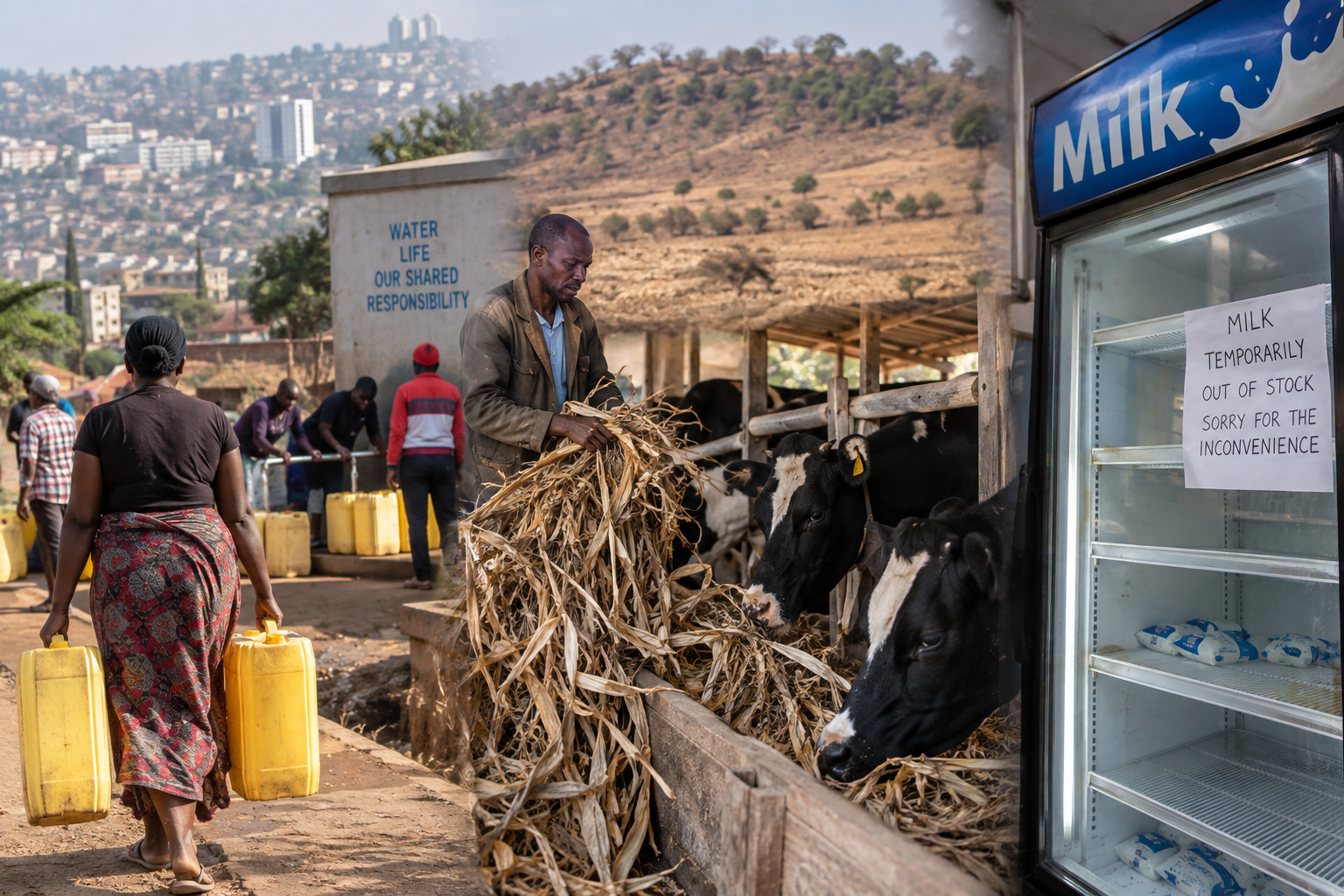
“We spend some days without water,” Mugisha told the media in August. For his household, the shortage meant buying a 20-litre jerrycan for about Rwf500, an expense that quickly became difficult to sustain. His experience was being repeated in several parts of Kigali as Rwanda moved through a prolonged dry season that has strained water supplies, livestock production and ecosystems.
Now, as September brings the prospect of returning rains, the question is changing. After months of heat and dryness, what exactly happened, and what will the coming rains bring? A dry season felt far beyond the thermometer.
Rwanda’s June–August period is normally one of its drier periods. However, this year’s conditions have been felt not only in people’s experience of heat, but through water shortages, declining livestock productivity and growing pressure on natural resources.
The Water and Sanitation Corporation (WASAC) introduced a temporary water-rationing plan in July for selected areas of Kigali and surrounding districts, citing reduced water availability during the dry season. The affected areas included parts of Kicukiro, Gasabo and Nyarugenge, as well as Bugesera, Kamonyi and Rwamagana.
The city’s underlying water deficit is also substantial.
WASAC says Kigali requires about 210,000 cubic meters of water a day but produces approximately 145,000 cubic meters, leaving a daily gap of about 65,000 cubic meters. The dry season has therefore come on top of an existing structural shortage rather than creating the entire problem by itself.
For residents, however, the distinction offers little immediate relief.
In August, WASAC apologized for inadequate water supply in several parts of the country, including neighborhoods such as Kanombe, Ndera, Nyarugunga, Busanza, Kabeza, Rubirizi and Karama. Mugisha said the shortage was affecting basic household activities.
“We are forced to buy water at Rwf500 a jerrycan and it is getting too much for us,” he said.
The dry spell is also being measured in liters of milk
The impact has reached one of Rwanda’s most visible food chains: milk. In September, The New Times visited nine dairy outlets in Gishushu, Nyarutarama and Gisimenti in Kigali and found milk available at only one of them. Retailers said supply problems had persisted for weeks. But the shortage in Kigali began much earlier in the production chain.
In Nyagatare District, farmer Emmanuel Nkubito keeps about 30 cows and produces fodder for other farmers. He said that demand for fodder had risen beyond what he could supply.
“Farmers are asking me for fodder, but I also have to feed my own cattle,” Nkubito said.
The dry conditions have made the problem more complicated. Nkubito said that even when fodder is harvested, a lack of equipment could cause losses before it reaches farmers.
“I harvest the fodder and wait for a baling machine to arrive, but sometimes the sun dries the fodder before the machine comes,” he said.
Another farmer, John Ruyange in Gatsibo District, described the situation more starkly, saying farmers had not experienced such dryness in a long time and that livestock losses had occurred.
Regional reporting found that milk deliveries from some production areas had fallen sharply as farmers struggled with water and pasture shortages.
The consequences are now visible in Kigali.
Inyange Industries, Rwanda’s largest dairy processor, attributed the current milk shortage to the prolonged dry season, saying reduced milk production volumes had affected supplies. For consumers, the shortage has meant empty refrigerators, rationing in some shops and pressure on businesses that depend on milk.
One Kigali coffee-shop operator told Taarifa Rwanda: “We are under serious pressure.” The business, she said, was caught between difficulty finding milk and the risk of losing customers if prices increased. The dry season, in other words, has moved from the pasture to the city counter.
What does the weather data say?
Meteo Rwanda’s own 2026 forecasts provide important context, although they should not be confused with measurements of what actually happened.
Its June 2026 forecast projected rainfall of between 20 and 120 millimeters nationally, slightly above the long-term mean for June, with maximum temperatures expected to reach 27°C to 30°C in many parts of Kigali City and the Eastern Province.
That forecast alone does not prove that 2026 was hotter or drier than previous years.
To establish that conclusively, the relevant comparison is between the observed 2026 temperature and rainfall records and the historical climate normal, preferably using Meteo Rwanda’s station data for Kigali and other representative locations.
Meteo Rwanda maintains climatological bulletins and a climate-data service through which historical climate data can be requested. That distinction matters because weather perception and meteorological measurement are not always the same thing.
The evidence already shows that the dry conditions had significant consequences. However, whether 2026 was record-breaking, and by exactly how much, requires the observed station data. The regional climate signal Rwanda’s experience is also occurring within a wider regional climate pattern.
The World Meteorological Organization has warned that the developing El Niño is expected to influence conditions across the Greater Horn of Africa, with the final quarter of 2026 expected to be warmer and wetter than usual in parts of the region.
El Niño can influence rainfall and temperature patterns, but it should not be used as a single explanation for every weather event in Rwanda. Nor should the current heat automatically be described as a direct consequence of climate change.
Long-term warming may influence the background conditions in which extreme weather occurs, while natural climate variability such as El Niño can influence individual seasons. For that reason, establishing how much of Rwanda’s 2026 experience can be attributed to climate change requires formal climate attribution analysis rather than assumption. The landscape is also under pressure
The consequences extend beyond households and farms.
The Rwanda Environment Management Authority has warned of increased wildfire risks in and around Rugezi Marshland during prolonged dry conditions. Rugezi is not simply another piece of vegetation. The wetland plays an important role in Rwanda’s water system, including its connection with Lakes Burera and Ruhondo.
When vegetation becomes dry, the risk of fire increases. At the same time, prolonged lack of rainfall can place additional stress on water-dependent ecosystems.
The extent of the ecological damage, however, requires measurement. The number of fires, affected hectares, water levels and changes in vegetation should be compared with previous years before conclusions are drawn about the scale of the environmental impact.
And now, the rain is coming
The irony of Rwanda’s 2026 weather story is that the country may soon be preparing for the opposite problem.
Meteo Rwanda’s September–December 2026 seasonal forecast, released on August 21, indicates a high probability of above-normal rainfall across Rwanda.
MINEMA says the country could receive between 300 and 1,000 millimeters of rainfall during the September–December season, compared with a long-term range of approximately 279–962 millimeters. The agency has already mobilized communities to prepare for heavy rainfall and related hazards.
The preparation is practical.
During the August 29 Umuganda, communities were encouraged to clear drainage channels, reinforce roofs, strengthen anti-erosion measures, manage rainwater and reinforce vulnerable houses and infrastructure. MINEMA Permanent Secretary Aristarque Ngoga said the country should act before disasters occur.
“The weather forecast indicates that the coming season is expected to bring heavy rainfall,” he said. “That is why we have the responsibility to warn residents that prevention is better than waiting for disasters to occur.”
From drought pressure to flood risk
The return of rain will be welcome news for farmers struggling with dry soils, livestock keepers looking for pasture and households facing water shortages. But more rain does not automatically mean recovery. After months of dryness, communities still need to manage erosion, protect slopes, maintain drainage and remain alert to heavy rainfall.
Rwanda has experienced the consequences of extreme rainfall before. The country’s disaster-management authorities therefore emphasize preparedness rather than waiting until flooding or landslides begin.
The current forecast does not mean that catastrophic flooding is inevitable. Seasonal forecasts indicate probabilities and broad conditions rather than predicting exactly where and when individual storms will occur. What it does mean is that Rwanda is moving into another period of weather-related uncertainty.
What 2026 is revealing
The story of Rwanda’s long dry spell is ultimately not just about temperature. It is about what happens when weather conditions meet existing vulnerabilities. Kigali’s water shortage exposed a gap between urban demand and available supply. The milk shortage showed how conditions on farms could eventually reach consumers in the capital.
The experience of farmers such as Emmanuel Nkubito showed how the availability of water and fodder could determine whether livestock remain productive. In addition, the warnings around Rugezi highlighted the vulnerability of ecosystems when dry conditions persist. Now, as the rains return, the test will be whether those lessons translate into preparedness.
For Rwanda, resilience will require preparing for both sides of the climate equation: too little water and too much of it. The immediate question is no longer simply whether the heat will break. It is whether the country can turn the experience of this dry season into better preparation for the rains ahead.