When the appeal trial of Claude Muhayimana opens before the Paris Court of Appeal in February 2026, it will not simply reopen a legal file. It will bring back memories, for survivors of the 1994 genocide against the Tutsi in Rwanda, for the accused, and for a French justice system increasingly called upon to judge crimes committed far beyond its borders.
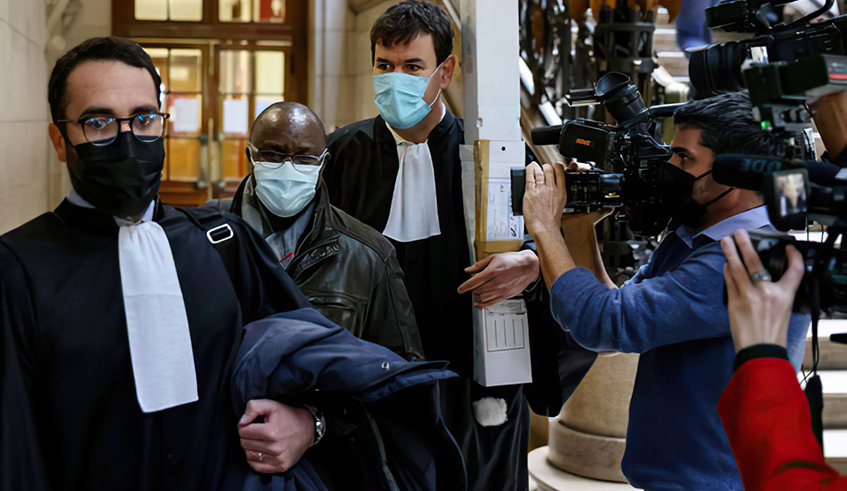
I covered the first trial as a journalist from the courtroom of the Paris Court of Assizes, held between 22 November and 17 December 2021. What unfolded there was not only a judicial confrontation but a deeply human one, marked by testimonies of survival, denial, silence, and the long shadow of a genocide that continues to demand accountability more than three decades later. For several weeks, the court heard survivors, expert historians, investigators, and the accused himself, all attempting, in different ways, to reconstruct events that occurred nearly thirty years before.
The accused and the charges
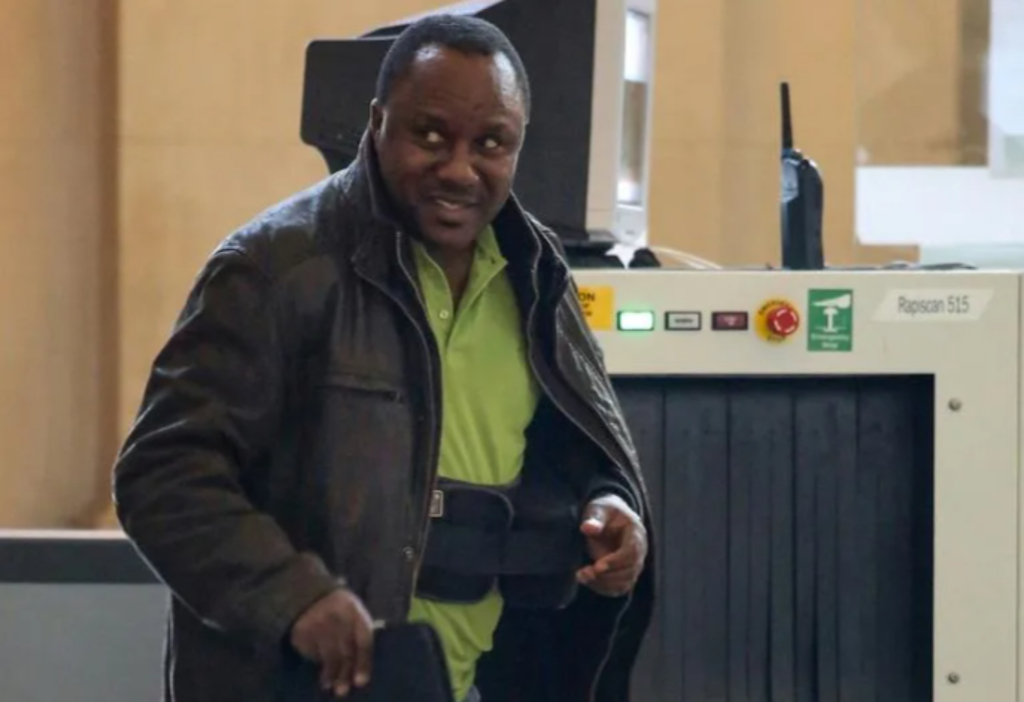
Claude Muhayimana, a naturalized French citizen of Rwandan origin at the time of his arrest in 2014, was charged with complicity in genocide and complicity in crimes against humanity. The prosecution alleged that during the genocide, Muhayimana worked as a driver in the Kibuye region (now Karongi District), and that he knowingly transported members of the Interahamwe militia to sites where massacres of Tutsi civilians were carried out.
Muhayimana denied the accusations throughout the trial, presenting himself as an ordinary civilian navigating a violent and chaotic context, without genocidal intent.
The court and its composition
The trial took place before the Paris Court of Assizes, which, in cases of crimes against humanity, is composed of three professional judges and a jury selected from French citizens. This mixed composition places citizen jurors alongside magistrates in judging some of the gravest crimes under international law.
Expert testimony and the question of “mobility”
Among the most significant moments of the trial were the hearings of expert witnesses, particularly historians specializing in the genocide.
Hélène Dumas, a historian and research fellow at CNRS, provided testimony that became central to the court’s understanding of the case. Her analysis focused on the notion of mobility during the genocide, who had it, who controlled it, and who was deprived of it.
She explained that mobility was a form of power in 1994 Rwanda. Militias who could move freely were able to hunt, surround, and kill. Victims, by contrast, were often trapped, hiding, or immobilized by fear and roadblocks.
According to Dumas, what incriminated Muhayimana was not direct participation in killings, but the fact that he allegedly facilitated mobility, transporting militia members to massacre sites. In her words, mobility was “one of the essential supports of the genocide,” and those who enabled it played a functional role in the machinery of violence.
Witnesses, memory, and the limits of proof
Survivor testimonies formed the emotional core of the trial. Witnesses described roadblocks, attacks, and the terror of being pursued. Yet the passage of time weighed heavily on the proceedings. Defense lawyers challenged the reliability of memories formed under trauma and recalled decades later, while prosecutors argued that consistency across testimonies and historical context gave them credibility.
This tension between lived memory and judicial proof remained present throughout the hearings.
The verdict
On 17 December 2021, the court found Claude Muhayimana guilty of complicity in genocide and complicity in crimes against humanity and sentenced him to 14 years in prison. The judges and jury concluded that he had knowingly provided assistance that facilitated the commission of genocidal crimes, even without evidence that he personally killed.
Civil parties, including survivor associations, welcomed the verdict as another step toward accountability. The defense immediately filed an appeal.
Appeal and release under judicial supervision
Following his appeal, the legal situation evolved in a way that was widely misunderstood. In December 2022, the Paris Court of Appeal ordered Muhayimana’s release under judicial supervision while awaiting the appeal trial.
Under French criminal procedure, an appeal places the accused in a procedural position close to that which existed before the first-instance judgment, unless continued detention is justified.
Judicial supervision does not amount to freedom: it may include residence requirements, travel restrictions, and regular reporting to authorities. It is a procedural measure, not a judgment on guilt or innocence.
What lies ahead?
According to judicial schedules monitored by Ibuka France, the appeal trial is expected to take place in Paris from 2 February to 27 February 2026. In French law, an appeal in criminal matters involves a full rehearing of the case. Witnesses may be called again, expert analyses revisited, and the sentence confirmed, modified, or overturned.
For survivors, the reopening of the case can revive painful memories. For the accused, it represents a final opportunity to contest a conviction carrying both legal and moral weight.
A broader context
Muhayimana’s case is part of France’s effort to prosecute suspects of the 1994 genocide against the Tutsi under universal jurisdiction. Since the first major conviction in 2014, when a Paris court sentenced former Rwandan intelligence officer Pascal Simbikangwa to 25 years’ imprisonment for complicity in genocide and crimes against humanity, French courts have handed down several other significant rulings.
In 2016, two former bourgmestres, Octavien Ngenzi and Tito Barahira, received life sentences for organizing mass killings in eastern Rwanda. In 2022, former official Laurent Bucyibaruta was sentenced to 20 years.
In 2023, a Paris court sentenced Doctor Sosthène Munyemana to 24 years in prison for genocide and related crimes. On appeal in 2025, the Cour d’assises d’appel de Paris confirmed the 24‑year sentence for genocide while acquitting him of most other charges. His defense has since filed a pourvoi en cassation challenging the decision. Meanwhile, Philippe Hategekimana received life imprisonment for genocide and related crimes.
These trials, held far from Rwanda, raise complex questions about time, distance, memory, and the capacity of courts to judge mass crimes decades later.
As the appeal approaches, Muhayimana’s case will again test the ability of justice to speak carefully, fairly, and credibly, about one of the darkest chapters of the late twentieth century.