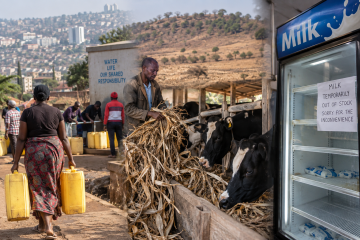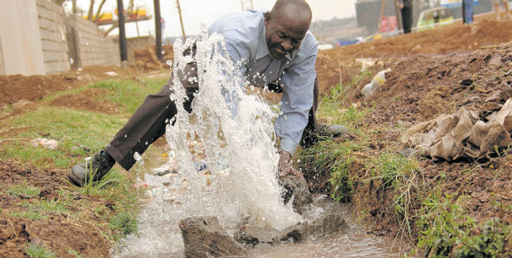
In Kigali, access to water is not just about infrastructure; it is about inequality. In some neighborhoods, taps run daily. In others, residents wait days, sometimes weeks, for a single drop. The difference, according to WASAC (Water and Sanitation Corporation), may not lie in how much water Rwanda produces, but in how much of it never reaches users.
A city of two realities
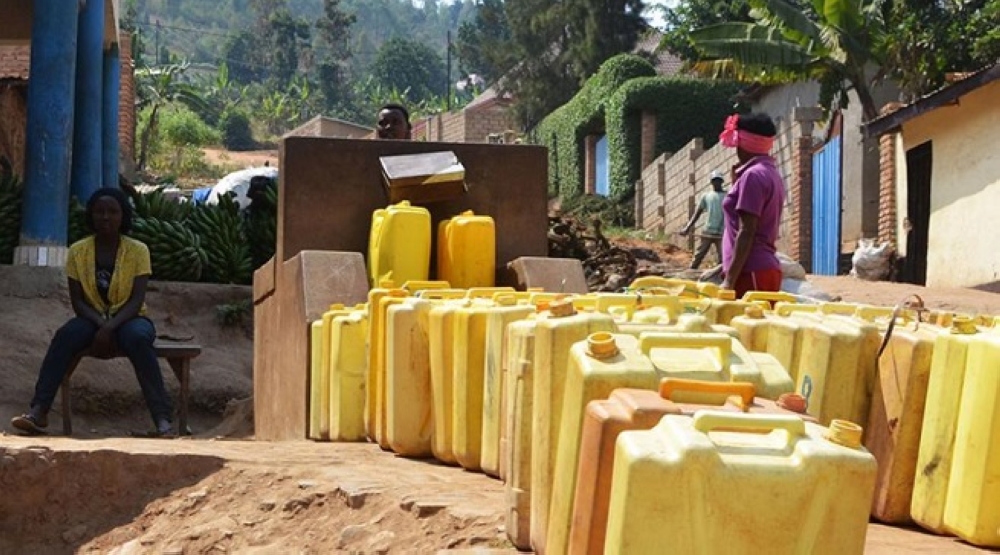
In Ndera Sector, Gasabo District, residents describe water as something almost mythical. Celestin Ndagijimana says that seeing water in the tap is like a miracle. “Sometimes even the bathroom is dry,” residents joke, adding that they even sweep the bathroom to keep it clean.

“We rely on rainwater when it is the season, and when water does come, we have to store it in many containers. Otherwise, water is so expensive in our neighborhood. One jerrycan costs 500 Rwandan francs from vendors who use bicycles to fetch and sell it.” Said Ndagijimana.
A similar story unfolds in Kanombe Sector, Kicukiro District, where residents have adapted to uncertainty. Docile Nyiraneza says that in their neighborhood, they have created communication channels to “ambush” the water.
“We created a WhatsApp group. When water comes, the first to notice alerts others, and even at night we run with buckets to fetch and store as much as we can,” she said. “Water here is not scheduled; it is chased.” She added.
Behind these coping strategies lies a deeper systemic issue beyond household control.
Meanwhile, just a few kilometers away, the situation is different. In places like Niboyi in Kicukiro District and Nyarutarama in Gasabo District, residents say water flows regularly. Having storage tanks is a precaution, not a necessity; life continues uninterrupted.
This contrast within the same city raises a critical question: why does water reach some areas consistently while others remain dry?
The missing water: a systemic problem
A key factor behind Kigali’s uneven water access lies in what experts describe as a systemic loss within the distribution network. According to the Water and Sanitation Corporation, a significant portion of treated water in Rwanda never generates revenue, meaning it is lost before reaching paying customers.
In 2023, non-revenue water stood at 44.1 percent, although the utility says this has recently been reduced to around 38 percent following targeted interventions. These figures suggest that a substantial share of the country’s treated water effectively disappears within the system.
Understanding non-revenue water
Non-revenue water (NRW) refers to water that is produced but not billed to consumers. According to the Water and Sanitation Corporation, this includes physical losses such as leaks in pipelines, as well as commercial losses arising from illegal connections, faulty or inaccurate metering, and operational inefficiencies.
Recent data highlights the scale of the issue. In a single year, Rwanda produced approximately 76.63 million cubic meters of water, yet about 30.27 million cubic meters, nearly 40 percent was not billed. Beyond the technical implications, these losses translate into billions of francs in foregone revenue for the utility.
For residents in Ndera and Kanombe, these figures are not statistics, they are daily experience.
How losses translate into inequality
Water experts emphasize that non-revenue water is not only a financial concern but also a critical factor in determining who has access to water. When large volumes are lost within the system, the overall supply reaching consumers is reduced.
This leads to lower pressure in the network, particularly in areas located far from main supply lines or at higher elevations. As a result, water distribution becomes intermittent, with some neighborhoods receiving irregular or no supply at all.
The impact is not evenly felt. Peripheral communities, high-altitude zones, and rapidly expanding settlements are often the most affected, while centrally located or well-connected areas tend to maintain more stable access.
Infrastructure under pressure
Studies on Kigali’s water system indicate that rapid urban growth has outpaced infrastructure development, placing increasing strain on existing networks. Pipelines designed for smaller populations are now expected to serve expanding communities, reducing overall efficiency.
Even where water production has improved, limitations within the distribution system mean that supply cannot always be delivered evenly across the city.
Beyond infrastructure: the human factor
While technical challenges play a major role, the Water and Sanitation Corporation also attributes water losses to human factors, including vandalism and unauthorized consumption.
In practice, this includes illegal connections in underserved areas, damaged pipes that remain unrepaired, and aging infrastructure that allows water to leak unnoticed underground. For some residents, such practices are less about criminal intent and more about survival in areas where formal access remains unreliable.
National ambition vs urban reality
The Government of Rwanda has set ambitious targets to achieve universal access to clean water and reduce system losses as part of its national infrastructure strategy led by the Ministry of Infrastructure (MININFRA).
Speaking during a national water sector initiative, Patricie Uwase, Minister of State in the Ministry of Infrastructure, emphasized that Rwanda continues to prioritize expansion and efficiency in water service delivery as part of its broader development agenda.
At the operational level, the Water and Sanitation Corporation (WASAC) acknowledges that reducing system losses remains a central challenge. During a Non-Revenue Water management initiative, WASAC Group CEO Dr. Asaph Kabaasha stated:
“Non-revenue water is one of the utility’s most pressing challenges.”
While investments in infrastructure and system upgrades are ongoing, officials note that disparities in access remain visible across Kigali.
As Kigali continues to grow, the challenge of water access cannot be solved by infrastructure alone. It requires shared responsibility at every level of society.
For citizens, reducing waste, reporting leaks, and avoiding illegal connections are small but meaningful actions that collectively help preserve a limited resource. For institutions, the urgency is even greater to accelerate repairs, strengthen monitoring systems, and close the gaps where water is lost before it reaches those who need it most.
Ultimately, reducing non-revenue water is not only a technical or financial necessity; it is a collective duty. Because every drop saved is a step toward fairness in access, and every delay in action deepens the divide between those who have water every day and those who still wait for it.